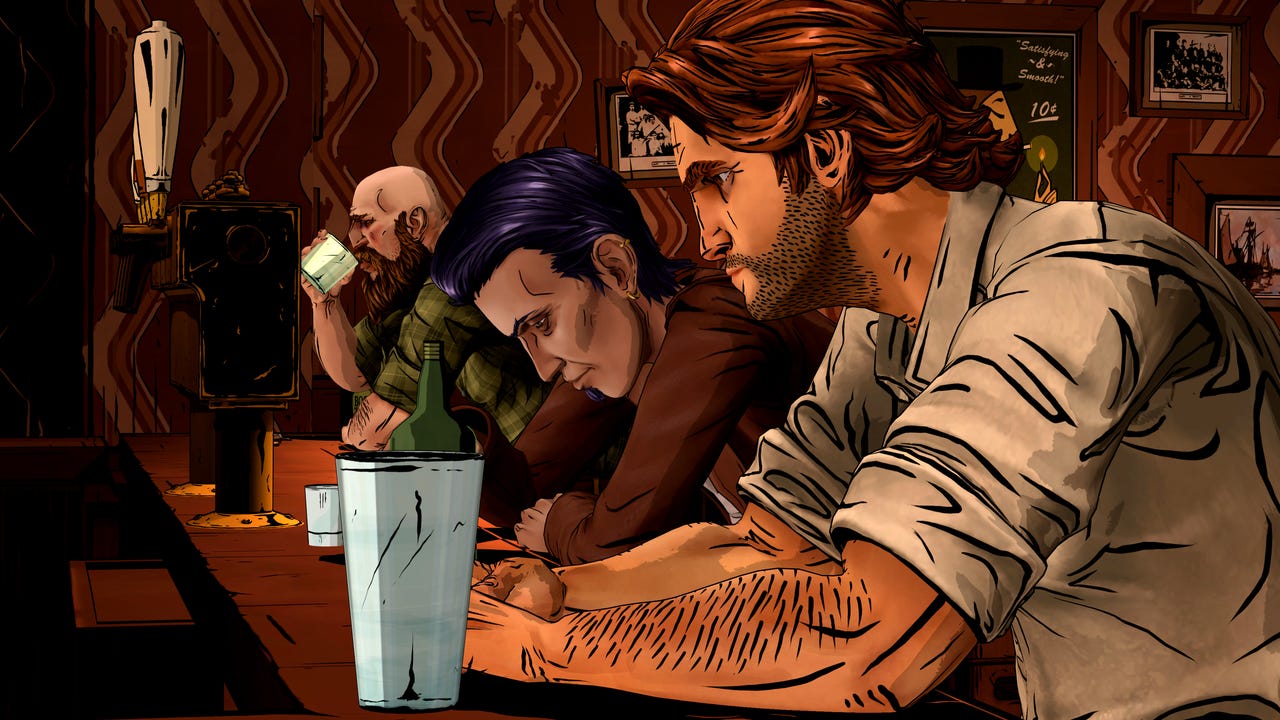
Nearly a decade on from Telltale Games’ first announcement of a Wolf Among Us sequel, there’s finally some good news. The rebooted version of Telltale has committed to a 2027 launch for Bigby Wolf’s long-awaited next chapter, as well as a remastered version of his first adventure due out later this year.
But what has taken so long? Well, the project has survived the shuttering of Telltale in 2018 and the brand’s subsequent revival, a subsequent reboot, numerous delays, layoffs, and the now-dissolved partnership with Dispatch maker AdHoc Studio — which worked on the game for several years. But, as Telltale Games CEO Jamie Ottilie discusses with IGN below, that’s only part of the story.
Read on for detail on why Telltale restarted work on The Wolf Among Us 2 back in 2023, what became of the company’s partnership with AdHoc, and how much of the Dispatch developer’s work remains in the game — plus, Telltale’s plans for the future, and whether we’ll ever see a Wolf Among Us 3.
IGN: I’m looking forward to replaying The Wolf Among Us. Obviously there have been reports of a remaster, but it’s definitely been long enough since the original.
Jamie Ottilie: That’s good to hear. Some people are on the fence about remasters and why would you be? It’s 13 years old and we want to preserve it and make sure it runs on modern consoles and that new people can experience it. Why wouldn’t we do it?
And I guess you want the sequel to launch to as big an audience as possible and the first one coming back again helps grow that audience, 13 years on.
Ottilie: Yeah, I can’t believe it’s been so long. The anniversary is this October. The remaster should be coming contemporous with the anniversary. Should be.
Because it’s been so long, fans have wondered if Wolf 2 will tell a completely different story to avoid alienating anyone — even if many hope at least some aspects continue from the first game to the second. What can you say there?
Ottilie: It’s a new story but it’s certainly a Bigby story. It’s contemporous from a timeline standpoint with the first one. It’s a true sequel. You don’t need to play the first one to understand it, but it will help. It’s the same universe, the same characters, fans should be very happy with what we’re doing with the sequel.
The original ended on something of a cliffhanger, or the suggestion of a reveal. Can you say whether that will be addressed in the sequel?
Ottilie: I can’t say that right now. The other folks on my comms team are on this call will get very upset with me if I answer that question, but some of that will get covered at Summer Games Fest. I can say we do think fans will be very happy with what we’re doing with the story and how we’re respectfully treating some of the content from the first one.
Out of all the original Telltale games, why is the new Telltale so committed to The Wolf Among Us like this?
Ottilie: Some of it’s selfish [laughs]. I think it’s important, it’s one of my favorite games. One of the things that Mike and I bonded over is it’s one of his favorite games. Quietly in conversations, you’ll find that a lot of people will express that and put it in their top five or their top 10. It deserves a sequel. One of the reasons I chose to get involved with this iteration of Telltale was to see this sequel through. That level of desire is there and it isn’t just me, it’s everybody on my team. When I talked about putting Telltale back together with the folks who helped me do it, this was central to the conversation. So it’s been there from the very beginning in terms of like, why are you doing this? What are you doing? Well, we’re going to make this game, then we’re going to figure the rest out.
It’s been a longer journey than any of us had hoped. It’s hard for me to believe it’s been seven years. It’s been hard to be quiet the last few years while we got our stuff together and got the game going, but we’re here now, it feels pretty good.
The Telltale brand still holds a lot of love from fans and there’s a lot of curiosity around where the company as a whole is at. Can you get into the team’s current size, and how much you’re handling development internally? Obviously you’ve worked with Deck Nine on The Expanse, and then I believe it’s Trick Studios you’re now working with on Wolf 2?
Ottilie: Yeah, Trick is our co-dev partner. We’re working with Trick on a myriad of things and have been for a couple years now. One of the things that we decided to do as a company in terms of how we built this iteration of Telltale was to understand that development is cyclical. Your staffing meets are not consistent across a three-year period or a four-year period and rather than the boom bust cycle that we all went through in terms of hiring and laying off, that we would build intelligently around co-dev. So people that are internal to Telltale are really focused on leadership positions we know we’re going to need for the long-term, structured around what the components of a Telltale game are and how we work effectively with co-dev partners to deliver that when you need to be at scale making content.
That’s been part of our business plan really from the outset. We did The Expanse externally with Deck Nine because we acknowledged that trying to do two games at the same time with a company from scratch is really not a great business plan. There’s always been the understanding that you have to focus on what you can do. It’s taken us longer than we intended because we did a tech reset in 2022. We originally started off with the legacy Telltale tool [and] Unreal Engine 4, and on paper that looked like [it would provide] all sorts of good production gains and tools and scalability and iteration. And a couple years into that journey the reality that like, ‘no, that’s not going to be true’ became obvious. And so we did a reset on pipeline and went back to square one in terms of how we were building the content, not what content we were building, but how we were structuring it, how we were building it.
There’s a lot of cinematic minutes that go into a Telltale game and building those at quality [and] efficiently is kind of the central problem to how you run the company.
So, Telltale still has its own development staff?
Ottilie: [It’s] 40% internal, 60% external from a rule of thumb standpoint. We work with Trick. We also have a couple subject matter experts for some things like character rigging — it’s super important and super specialized, but you also only need it for a [specific] period. And when you’re done with it, those are very expensive, very talented people that don’t have a lot to do for the rest of the title. So stuff like that is outsourced in the traditional way [to] subject matter experts and then Trick and Telltale have structured an integrated team. We don’t do traditional co-dev that’s asset based or output based. We run one team, and where those people happen to collect their paychecks is irrelevant from a team structure standpoint. It all works under the same management system, the same standups, the same milestone basis, the same sprints. And so that’s been a really effective way for us to work together. We’ve invested a couple years in our relationship with Trick, getting to the point where we can function this way.
How did the Wolf Among Us Remastered project get started?
Ottilie: Wolf 1 has been, because it’s on the legacy engine and a bespoke code base, it is harder to work with than doing stuff from scratch, just because there’s a great deal of institutional knowledge that’s necessary to be able to wield those tools. We’re about a year and a half into the journey on the remaster for Wolf 1. It really started out of ‘we need to update this to keep it current on consoles and functioning and there are some bugs here that are pretty egregious that would be nice to get rid of as we’re playing through this.’ And then we did some experiments with, is it possible to make it look incrementally better and what would that look like? And so Wolf 1 just kind of grew organically out of that, wanting to continue to support it, wanting to see it stay in the market and be a really clean experience for new players that come in and want to play through it.
And then, you called it out earlier, we’re doing the sequel. The best way to introduce people to the sequel is to let them play the first title. And so it made business sense, it made production sense. It made sense as fans of the content and materials to do it. So that’s been effectively moving forward, a very slow burn with the right approach, training new folks to work with the tools and tech and standing that stuff back up and ensuring that we could do it effectively.
How was development impacted by the Ad Hoc leaving? Can you talk about why that partnership ended, and how far it got?
Ottilie: We were working with Ad Hoc in the same way we were working with Trick, as an integrated team. It was not like a Deck Nine situation where we had an [external] developer. When we started working with Ad Hoc, they were relatively new. They were effectively four people, three of which had worked on Wolf 1. So it was natural for us to work together. When we did the tech reset and we realized that we’re not going to be producing content for at least a year in terms of how we’re approaching this, it didn’t make sense for us to keep them tied up and effectively sitting on the sidelines not doing a lot while we went through the pipeline and [worked out] how we were going to build the content. And so it sort of came to a natural break point based upon the reality of where we were from a pipeline standpoint and they obviously had desires to ship their own games and did not want to be idle either.
And I don’t know if you know the core history of the team, but the core group’s been together for 11 years across multiple companies on a journey to ship games and they deserved to be able to go out and do that and make that happen. So we just sort of got to a place where it didn’t make sense for us to keep them tied up, as much as we wanted to collaborate on this title. And then by the time we were ready, they were off doing Dispatch as we all know now and it wasn’t really effective to reintegrate them into the team. Unfortunately, timing works that way sometimes.
It sounds like from your side, the reset was just a technical thing you wanted to do.
Ottilie: It was the reality that we weren’t going to ship on the path we were on, we were not going to ship a game worthy of the name [The Wolf Among Us] based upon how the content was coming together, what the pipeline looked like. It was a hard choice to do a reset. Nobody wants to do that. I’m not saying it was easy on anybody, I guess is what I’m trying to say. It’s not the decision anybody wanted to make, but I think we all understood the nature of the decision of why it had to be made.
Can you shed any light on how much of AdHoc’s work remains in the game?
Ottilie: Certainly there’s some pieces of it that are there, but at the end of the day, when you do a complete reset, you have to reset with the creative leadership you have and how you’re building the game. So it certainly isn’t the same game as envisioned that was there. Some of the gains we were expecting on the tools and pipeline were about how much content we could create in a given period of time on a given budget number and that wasn’t going to come to fruition either. So the number of minutes and the scoping had to be different than where we were in terms of how we approached the content. There are elements of it, but it’s a different game is probably the best answer that I can give. There are people that have been working on the title from its inception consistently. So there is some continuity in the team, and it’s very difficult to draw like a clean line, ‘Oh, this is the Ad Hoc version. This is what was going on here.’ It was always a collaborative approach to how the content was being built.
Is there anything more you want to say now, to reassure fans after this bumpy development process? Obviously Dispatch is now out, and has been this huge success which is great to see.
Ottilie: It’s a great game. I would say internally we’re thrilled that Ad Hoc got to go away and make Dispatch. The weird thing about narrative [games] is that none of us really think of each other as competitors. We’re in such a niche piece of content that there’s definitely a sprite of core in terms of people who make this kind of content. We’re all rooting for each other. In terms of reassuring the fans, let’s show you what we have at Summer Games Fest. We’re pretty confident what we have will make Wolf two fans happy. We’ve shown it to enough people to know that we’re on the right path here. We get a very positive response from when we take people into what we’re doing right now.
We are trying to be good stewards of the IP and the universe and everything that’s there. While from the outside it seems like we’ve been quiet and people have had their doubts about it, for the last seven years there isn’t a person on my team that hasn’t made this the priority professionally in their lives to get this game done. The amount of sacrifice and creativity that has been necessary to get us this far is incredible in terms of the team that’s there. There’s a great deal of passion, care, and love for this franchise in this team that is still there building it.
If everything goes well, what is your ambition for Telltale next? Is it more remasters, more sequels? Is there a particular focus? Is it Wolf 3? Is it bringing back another popular franchise from Telltale’s past? Where would you love to go?
Ottilie: We are actively looking at what we’ll do next. We’re working on what we’re calling a sequential slate, right? Instead of going wide, we’re doing things in parallel, one thing in a time. We’ll choose what we’re doing next this year and have it in concept development while we’re finishing up Wolf 2 so we know where we’re moving to when we’re done. There are quite a few games in contention for what that might be. It won’t be Wolf 3 out of the gate. I mean, there needs to be some breathing room between sequels. Certainly we’d love to do Wolf 3, but I think that’s a ‘ship this one, probably ship something else in between, come back to Wolf’, that kind of cadence. In a perfect world, we’d ship a new game every two years or so, taking about three years to make it, starting about a year prior so that there’s a little bit of overlap with concept teams.
We do a lot of writing and experimenting on paper. Before we move something into production, we throw away a lot of pages. Sometimes we write for an IP that we haven’t even talked to the licensor about just to see if it’s worth talking to the licensor about it. So we certainly have some ideas. There are three or four frontrunners in terms of what we’d like to do and there’s a blend in there. There’s some original IP in there. There’s some legacy Telltale stuff in there. There’s some new universes in there and I don’t think we’re ready to make that kind of commitment yet in terms of what’s next, but it’s top of mind for sure.
Tom Phillips is IGN’s News Editor. You can reach Tom at tom_phillips@ign.com or find him on Bluesky @tomphillipseg.bsky.social
About the Author